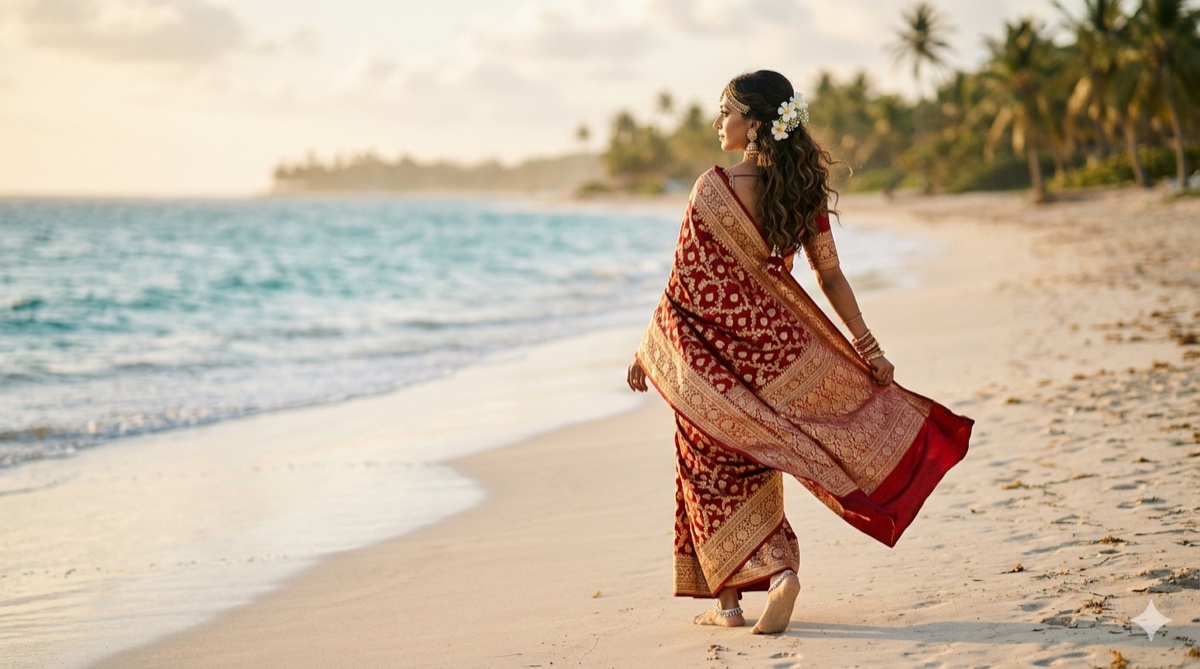
Mexico. The Caribbean. A villa in Tulum, a resort in Cancun, a private estate in Los Cabos. More South Asian couples are choosing destination weddings every year - and almost none of the advice out there is written for us. Generic destination wedding guides will tell you about beach hair and waterproof mascara. What they won’t tell you is how to fly with a Banarasi saree, what humidity does to a pre-pleated drape, or how to keep a full bridal base intact through a 90°F outdoor mandap.
I’ve travelled with brides across the US, Canada, Mexico, and the Caribbean, and the patterns are remarkably consistent. The brides who feel the most relaxed on the day made decisions about packing, prep, and logistics months in advance. The ones who didn’t spent the morning of their haldi troubleshooting a wrinkled pallu. Here’s everything I wish every destination bride knew before they booked their flights.
The Climate Reality Nobody Warns You About
Tropical destinations are warm, beautiful, and absolutely brutal on bridal makeup, hair, and silks. Cancun and Riviera Maya humidity sits around 75–85% for most of the year. Los Cabos is drier but the sun is uniquely intense. Even the “dry season” in the Caribbean (December through April, when most South Asian destination weddings happen) still runs warmer and stickier than anywhere in the continental US during the same months.
What that actually means for you:
- Foundations that look perfect in a Raleigh trial can slide off in 20 minutes on a Tulum beach.
- Natural hair texture - especially wavy and curly hair - will revert to its natural pattern within hours, no matter how recently it was blown out.
- Silks and georgette sarees absorb moisture from the air and lose crispness. Pleats fall flat.
- Heavy bridal jewelry sits on warmer skin and can leave marks if it’s not anchored properly.
None of this is a reason not to have your destination wedding. It just means the plan has to be built around the climate, not in spite of it.
Skin Prep Starts Six Weeks Out, Not One
Tropical air, long-haul flights, and the cocktail of welcome dinners, mehndi parties, and welcome-bag tastings will dehydrate your skin in ways you don’t expect. Start prepping six weeks before you travel, not the week before.
Sunscreen, Specifically for Melanin-Rich Skin
South Asian skin tans quickly and can develop melasma or post-inflammatory hyperpigmentation from even short, unprotected sun exposure - especially under the hormonal load of wedding stress. Two weeks before you fly, switch to a daily SPF 50 that doesn’t leave a white cast. Reapply every two hours once you’re at the destination, and put it on under your makeup on every event day, even indoor ones. Photos taken near windows or open-air mandaps will show the difference.
Hydration & Recovery
- Stop introducing new actives (retinol, exfoliating acids, peels) at least three weeks out. The flight and sun are not the time to test how your skin handles a new product.
- Add a hydrating serum and a heavier night cream than you normally use. Travel air is dry; your skin will thank you.
- Drink more water than feels reasonable. Most destination brides arrive mildly dehydrated, which shows up as dull skin in photos.
Packing a Saree for a Flight
This is the question I get most often, and the honest answer is: sarees do not love being folded into a suitcase for ten hours. Heavy embroidery creases. Zari can snag. Pure silks lose their structure. You have three reasonable options.
Option One: Roll, Don’t Fold
For a single saree, roll it loosely around a soft towel or pool noodle, slip it into a cotton garment bag, and place it on top of everything else in a hard-shell carry-on. Folding creates sharp creases right where you don’t want them - across the pallu, through the embroidered border. Rolling distributes the pressure.
Option Two: Carry It in a Garment Bag
Most international airlines will let you bring a garment bag as your personal item or hang it in the first-class closet if you ask politely at the gate. For a bridal lehenga or a heavily embroidered Banarasi, this is worth the small hassle. Never check anything irreplaceable.
Option Three: Have It Pre-Pleated and Shipped
This is what I’d genuinely recommend if you’re flying with multiple sarees, travelling solo, or simply don’t want to be your own draping team at a resort. I now offer door-to-door pre-pleating anywhere in the US and Canada. Your saree arrives at your home (or your hotel, if it’s a US-based pre-departure stop) already pleated, secured, and ready to step into in three to four minutes. No hunting for a local draper, no panicking over pallu pleats the morning of an event, and the pleats hold their shape even after travel because they’re professionally set.
“The single biggest stressor I see at destination weddings isn’t the makeup or the hair. It’s the saree. Solve that, and the morning of your event transforms.”
Hair That Survives the Tropics
Humidity is the great equalizer of bridal hair. A silk press done at home will puff up. A straight blowout will wave. A sleek low bun will frizz at the hairline. You have two real strategies, and I tell brides to pick based on their actual texture, not on what they wish their texture would do.
Strategy One: Lean Into Your Natural Texture
If your hair is wavy, curly, or coily, this is the wedding to embrace it. Curl patterns photograph beautifully under tropical light, and they don’t fight the humidity - they thrive in it. Loose curls pinned with fresh florals, a half-up textured style with a maang tikka, or a soft braided crown all read romantic in a way that a stiff blowout never can on a beach. This is one of my favorite parts of working with destination brides - the climate actually rewards your natural hair.
Strategy Two: Anchored Updos
If you want straight or polished hair, the only style that genuinely holds in humidity is a low bun anchored at the nape, set with a heavy hold spray, and given a wide-tooth setting period before any heat tools come anywhere near it. Even then, expect a touch-up between ceremonies. A high bun or sleek pony will start to lose its grip by the time the reception starts - the weight of your jewelry plus humidity will pull it down.
The Anti-Frizz Routine
- A leave-in serum applied to damp hair, not dry - this seals the cuticle before humidity can swell it.
- A silk pillowcase the night before. (Pack one. Hotel pillowcases are almost always cotton.)
- Anti-humidity finishing spray after styling, not before.
- Skip the dryer on the morning of an event if you can. Air-drying with curl cream and finger coiling gives you a softer, more photographable result in tropical air.
The Humidity-Proof Makeup Formula
A destination wedding base is built in layers, and every layer has to earn its place. Skip one and the whole structure slides.
- Primer with a grip finish - not a hydrating primer, not a glow primer. Something tacky that gives your foundation something to hold onto. Milk of Magnesia mixed with a regular primer, oddly, is a working artist secret for very oily skin in heat.
- A long-wear, transfer-resistant foundation - this is where Estée Lauder Double Wear earns its bridal reputation. I cover the specific products I’d reach for in my self-makeup edit, and most of them carry over to destination wedding kits.
- Cream products under powder - cream blush, cream bronzer, cream contour, all locked in with a fine setting powder. Powder products applied directly to hot skin will look patchy by the end of the ceremony.
- A real setting spray - not a hydrating mist. Something that bonds your makeup to your skin. Two passes: one after foundation, one as the final step.
- Blotting papers, not powder, for touch-ups - powdering over melted makeup creates texture. Blot first, then reset with a single light pass of setting spray.
Bringing Your Artist vs. Hiring Locally
This decision shapes your entire wedding week, and I want to be honest about both sides.
Hiring Locally at the Destination
Pros: No travel cost for an artist. The local team knows the
venue, the lighting, the weather.
Cons: Most resorts and local makeup artists don’t
specialize in South Asian bridal looks. They may not know how to balance a heavy
kundan set, how to apply red bindi placement that flatters your face shape, or
how to pin a dupatta so it survives a beach breeze. They almost certainly
don’t drape sarees in the regional style your family expects. You also
lose the trial-and-relationship process that takes a bride from anxious to
confident on the morning of the wedding.
Bringing a South Asian Bridal Artist With You
Pros: Continuity. The artist who did your trial in NC, who
knows your skin, your hair texture, your family’s expectations, and the
exact shade of your lehenga - is also the one with the brush on your
wedding morning. Multi-event coverage (sangeet, mehndi, haldi, wedding,
reception) by a single team who knows what you wore yesterday. Authentic regional
draping. And someone who has done this in tropical climates before and knows
what fails.
Cons: Travel, accommodation, and a destination fee added to your
package. For most brides this works out to less than the cost of stitching
together multiple local vendors who don’t specialize in South Asian looks,
but it’s a real line item to plan for.
For what it’s worth, I travel with brides across the US, Canada, Mexico, and the Caribbean regularly, and I structure destination packages so the math makes sense for the bride - not against her. If you want to know what that looks like for your specific destination and event count, just reach out and we can talk through it.
The Multi-Event Travel Capsule
A typical South Asian destination wedding runs four to six events across three or four days. Welcome dinner, mehndi, sangeet, haldi, wedding, reception. Your luggage allowance is the same as anyone else’s. Plan it like a capsule, not a closet.
- One outfit per event, no backups except for the wedding itself. The temptation to bring extras is real, but they add weight and stress.
- Choose lighter fabrics for the daytime events - georgettes, chiffons, light silks. Heavy Banarasi and tissue silks belong on the wedding day, not the haldi.
- One jewelry set per event, plus your bridal set. Pack jewelry in a hard case, in your carry-on, always.
- One pair of shoes per event is unrealistic. Two pairs cover most weddings: one heel for indoor events, one flat or kolhapuri for outdoor and beach events.
- A small dedicated saree pouch or garment bag, separate from the rest of your clothes. Sarees do not coexist well with toiletry bottles.
Your Destination Bridal Emergency Kit
I send every destination bride home with a version of this list. Pack it in your carry-on, not your checked bag.
- Safety pins in three sizes - the small ones for dupatta pinning, medium for blouse adjustments, large for emergency saree pleating.
- A small sewing kit with thread in red, black, and the color of your wedding outfits.
- Double-sided fashion tape and a small roll of medical tape.
- Blotting papers, mini setting spray, and a single tube of your wedding lipstick. Skip the rest of the makeup - your artist has the kit.
- Hair pins (a full pack), a travel hair spray, and a small comb.
- A travel steamer or a hotel-iron-friendly press cloth. Trust me on the press cloth.
- Pain relievers, antacids, and electrolyte tablets. Tropical heat plus event days plus emotion equals exhausted body.
- Phone charger, portable battery, and a converter plug for the country you’re in. (Mexico and most of the Caribbean use US-style plugs, but always double-check your specific resort.)
One Last Thing
The brides I see truly enjoy their destination weddings - not just survive them - are the ones who decided early that this was going to be different from a wedding at home, and planned for the difference instead of pretending it wasn’t there. The climate is different. The logistics are different. The pace is different. Lean into it. A beach mandap is not a hotel ballroom, and your photos and memories will be richer because of it.
And if part of leaning in is having someone with you who has done this before, who knows your skin and your style and how to drape your saree the way your nani would have wanted - that’s exactly what I’m here for.