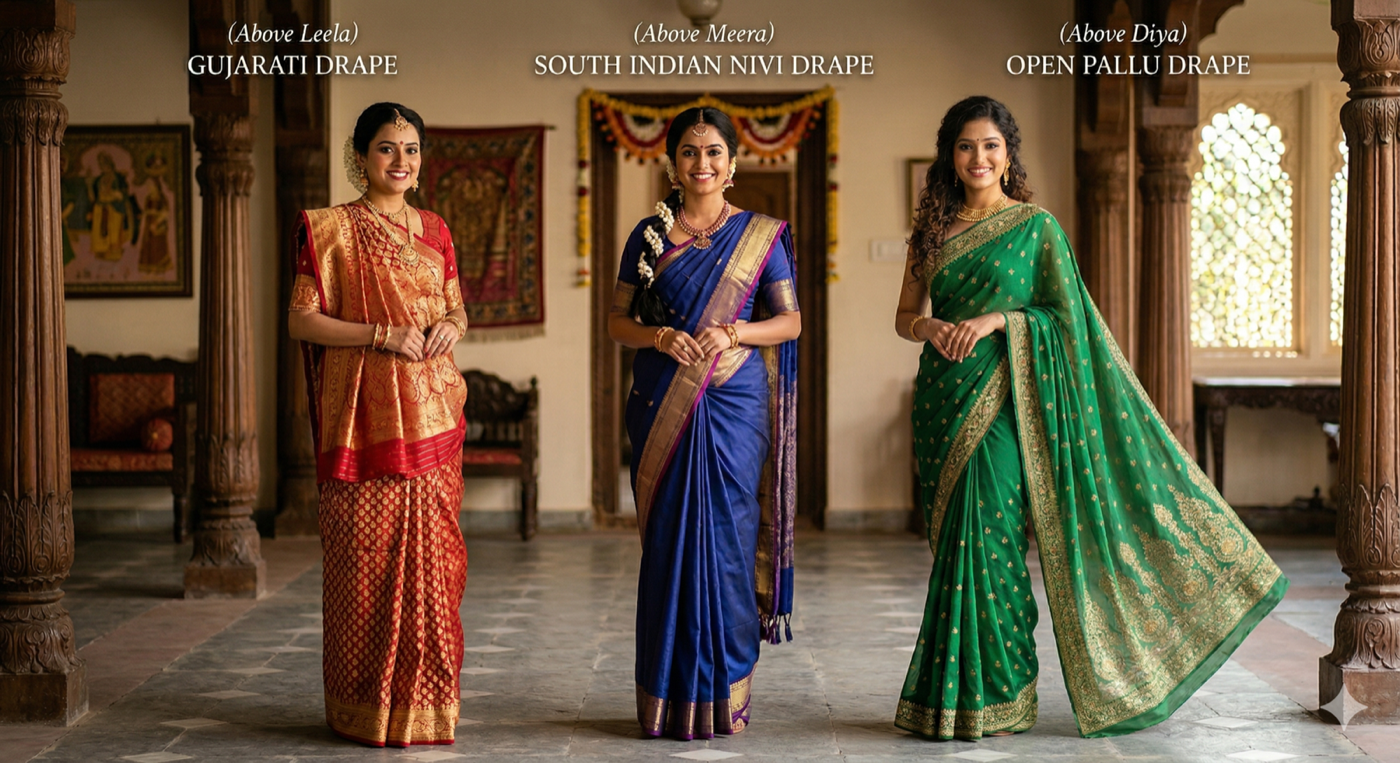
When a client reaches out about saree draping - whether it’s for her own wedding or a saree she’s sending in for pre-pleating - one of the first things I ask is which style she’s thinking about. Most of the time the answer is one of three: Gujarati, South Indian Nivi, or Open Pallu. Each of these tells a completely different story on the body, and choosing between them can transform the entire feel of a look.
Here’s a side-by-side guide to the three styles I drape most often, what makes each one special, and how to think about choosing between them for your next event.
1. Gujarati (Sidha or Front Pallu) Drape
The Gujarati drape - sometimes called seedha pallu or simply “front pallu” - is instantly recognizable by its forward-facing pallu. Instead of cascading down the back like most other styles, the decorative end of the saree is brought over the right shoulder from back to front, so the embroidery, zari work, or border falls gracefully across the chest.
It’s a drape designed to showcase craftsmanship. If your saree has a stunning hand-embroidered pallu, jewel-tone borders, or intricate mirror work, this style places the best of the fabric exactly where the eye naturally falls. It’s also one of the most structured of the three - the front pleats are crisp, the silhouette is polished, and the whole look reads as traditional and ceremonial.
When the Gujarati Drape Shines
- Heavily embroidered or embellished pallus that deserve to be seen
- Bandhani, patola, and other sarees with bold patterned pallus
- Garba and Navratri events where the pallu needs to stay secured during dance
- Receptions and engagement photography where the fabric is the star
- Brides who want a structured, polished silhouette
“The Gujarati drape is like framing a painting - it places the best of the saree exactly where the eye naturally falls.”
2. South Indian Nivi Drape
The Nivi drape is the style most people think of when they picture a “classic” saree. The pleats are tucked at the front and the pallu falls smoothly over the left shoulder, cascading down the back. It’s elegant, versatile, and timeless - and it works on almost every body type.
What I love about the Nivi drape is its quiet sophistication. It doesn’t shout. The vertical line from shoulder to hem creates an elongating effect, the pleats add structure at the waist, and the open pallu in the back gives just enough movement to feel graceful without being fussy. For brides wearing a traditional Kanjivaram silk, an Uppada, or any saree with an intricate body and a complementary border, this is almost always my recommendation.
When the Nivi Drape Shines
- Kanjivaram, Uppada, and other South Indian silk sarees
- Sarees where the body design (not just the pallu) is the focus
- Wedding ceremonies and traditional pujas
- Brides who want timeless elegance over high drama
- Photography that captures full-length silhouettes
3. Open Pallu Drape
The Open Pallu drape is the most contemporary of the three, and it’s the one I get the most questions about. Instead of pleating the pallu into neat folds at the shoulder, the entire pallu is left open and unpleated - spread wide across the back and over the shoulder - so the full design of the fabric is visible all the way down.
This is the style I reach for when a saree has a stunning all-over design on the pallu - think large floral motifs, gradient ombrés, statement borders, or dramatic prints - that would be lost if you pleated them up. It feels modern, confident, and a little bit editorial. Brides who love a fashion-forward look almost always gravitate to it.
When the Open Pallu Drape Shines
- Sarees with bold all-over pallu designs that need full visibility
- Designer and contemporary sarees with dramatic prints
- Cocktail receptions and engagement parties
- Brides who want a modern, fashion-forward silhouette
- Photography sessions where you want flowing, editorial-style shots
So Which One Should You Choose?
Honestly, many of my brides don’t choose just one. A multi-day South Asian wedding is a canvas for telling different sides of your style - I’ve draped the same bride in a classic Gujarati style for her sangeet, a traditional Nivi for her wedding ceremony, and an Open Pallu for her reception, all in the same week.
When you’re planning, think less about “which is best” and more about what each saree wants to be. Look at where the design lives on the fabric - on the pallu? on the body? on the border? - and choose the drape that puts that design front and center.
Did You Know? You Can Get a Pre-Pleated Saree
If draping a saree feels intimidating, or if you just don’t want to spend 30–45 minutes pleating on your event day, I offer door-to-door saree pre-pleating anywhere in the US or Canada. I drape and pleat your saree in your chosen style, package it carefully, and ship it to you ready to slip on in 3–4 minutes. It’s perfect for working women, brides juggling multiple events, or anyone new to wearing sarees.
And the best part? Because the saree is fully prepped, you can request the same fabric pleated in different styles for different occasions. One saree, three drapes, three completely different looks.